
How the Walther PPQ Evolved Into the PDP
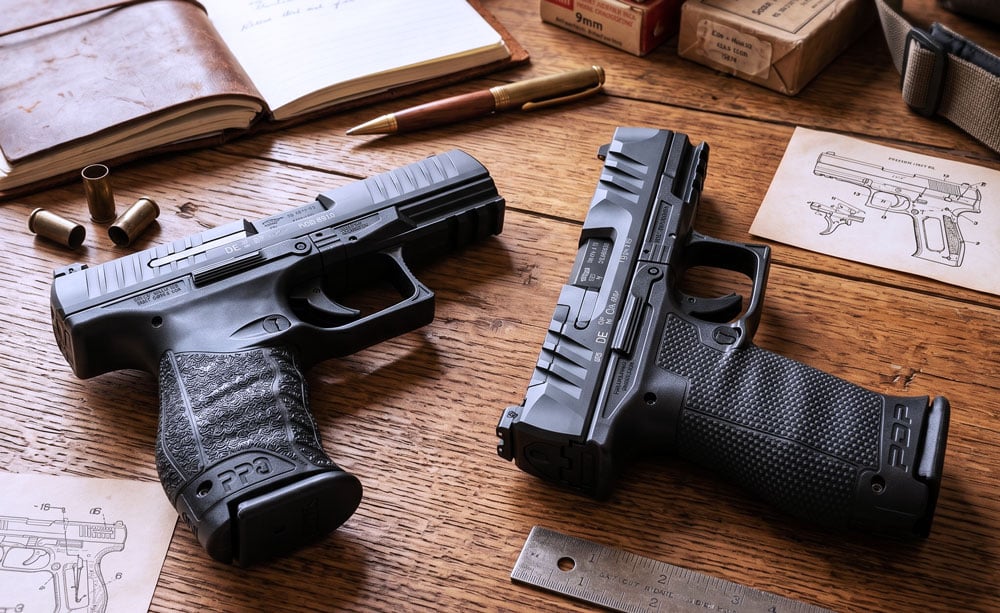
If you’ve spent any time behind a polymer-framed pistol over the last decade and a half, there’s a good chance you’ve heard someone rave about the Walther PPQ. Maybe it was a buddy at the range who wouldn’t stop talking about the trigger. Maybe it was a review that called it the smoothest striker-fired pistol on the market. Maybe you own one yourself and know exactly what all the fuss is about. Either way, the PPQ built a reputation that few modern handguns can match — and that reputation became the foundation for something even better: the Walther PDP.
This is the story of how one of the best pistols in recent memory grew into its next chapter.
The PPQ: Walther’s Modern Masterpiece
Walther has been building firearms since 1886, and the legacy of that craftsmanship has never been more evident than in the PPQ line. Introduced in 2011, the PPQ (Police Pistol Quick Defense) was built on the bones of the earlier P99 platform and refined for a new era of shooters. The idea was simple on paper but difficult to execute: build a striker-fired polymer pistol with a trigger so good it would change what people expected from the category.
They pulled it off.
The PPQ M2 — the updated version featuring a traditional push-button magazine release instead of the M1’s ambidextrous paddle — became the gold standard for trigger feel in a production polymer gun. The pull sits right around 5.6 pounds and remains virtually identical from the first shot to the last. There’s no stacking, no creep worth noting, and the reset is short enough that follow-up shots feel almost automatic. For a striker-fired handgun, that’s remarkable.
But Walther didn’t stop at the trigger. The PPQ M2 brought a full package: interchangeable backstraps for hand-fit customization, an ambidextrous slide stop, a Picatinny accessory rail, a low-profile snag-free design, and a sculpted grip that genuinely fits the hand rather than just wrapping around it. Two drop safeties and a firing pin block round out the safety system, all while keeping the gun in a constant cocked state for consistent draw-to-fire performance.
The PPQ also expanded across calibers. In addition to the 9mm variants, Walther offered the PPQ in .40 S&W and, notably, .45 ACP — making it one of the more versatile full-sized polymer pistol platforms on the market.
The PPQ M2 in .45 ACP: Big Bore, Same DNA
For shooters who want something with a little more punch, the PPQ M2 in .45 ACP is a serious option that GrabAGun still carries. This isn’t a watered-down adaptation — it’s a scaled-up version of the proven PPQ M2 platform, built from the ground up to handle the bigger cartridge.
The PPQ M2 .45 ACP features a 4.25-inch barrel and a matte black Tenifer-coated steel slide. Tenifer is worth calling out specifically: this surface treatment provides exceptional hardness and corrosion resistance that holds up in demanding conditions, whether that’s a wet hunting trip or hard daily carry. The gun runs a 12+1 capacity — respectable for a .45 — and ships with two magazines, interchangeable backstraps, and a hard case.
The frame is the same high-strength polymer as the rest of the PPQ line, with a Picatinny rail up front and a serrated trigger guard for positive finger placement. A 3-dot adjustable sight system lets shooters dial in their preferred zero, and the overall package comes in at 28.2 ounces and 7.4 inches overall — well-balanced and manageable for a .45.
The same legendary PPQ trigger is here too. The Quick Defense trigger system works with a fully pre-loaded striker assembly, requiring no decocker, and that consistent 5.6-pound pull keeps things predictable from the holster to the target. If you’ve wanted the PPQ experience in a bigger caliber, this is how you get it.
2021: The PDP Arrives
In February 2021, Walther quietly dropped a bombshell. They announced the PDP — the Performance Duty Pistol — and with it, the gradual retirement of the PPQ line. At first glance, the PDP looks like a significant departure. New slide profile, aggressive new “SuperTerrain” serrations, a different grip texture, and native optics-ready capability straight out of the box. Some PPQ loyalists were skeptical.
But here’s the thing: underneath all those changes, the PDP is still unmistakably a Walther PPQ at heart.
The PDP shares the same proven PPQ M2 internals. The same reliable action. The same fundamental geometry that made the PPQ so shootable. Walther didn’t tear things down and start over — they evolved what was already working and updated it for modern demands.
One way to see just how closely related these pistols are? We put it to the test ourselves: we mounted a Walther PDP slide onto an older PPQ M2 frame — both 9mm full-sized variants — and it slid right on. Literally. It worked with the original PPQ magazines too, no modifications needed. Now, we’re absolutely not recommending anyone run that configuration in the field. But the fact that it works at all tells you everything you need to know about the relationship between these two guns. The PDP is not a ground-up redesign. It’s a refinement of a proven platform.
What Actually Changed — and Why It Matters
So if the internals are closely shared, what did Walther actually change? Quite a bit on the outside, and a few meaningful things underneath.
The slide is more substantial on the PDP, with aggressive SuperTerrain serrations front and rear that give you a secure purchase even with wet or gloved hands. The slide profile is bulkier — a trade-off some PPQ owners take issue with aesthetically — but technically it’s a functional improvement for manipulation.
The grip texture is the PDP’s most immediately noticeable upgrade. Where the PPQ used subtle molded grooves, the PDP adopts the same aggressive Performance Duty Texture found on Walther’s steel-framed Q4 and Q5 competition pistols. It wraps further around the frame and bites harder under recoil. Not everyone prefers it — some PPQ fans find the original grip more natural to their hand — but for sweaty range sessions or duty use, the PDP grip holds more consistently.
The chamber received a subtle but meaningful internal update. Walther kept the rear of the PDP’s chamber to SAAMI specifications, just like the PPQ, but modified roughly the front third with a slight taper. This “stepped” chamber configuration centers the cartridge more precisely as it enters the rifling, with Walther claiming improved accuracy and velocity as a result. Whether you notice it at the range depends on the shooter, but the engineering intent is sound.
Optics readiness is arguably the PDP’s most significant real-world upgrade. The PPQ was not natively designed to mount a red-dot sight — adapting one required a trip to the aftermarket. The PDP ships optics-ready, with a slide cut that accepts a wide variety of micro red-dot sights directly. For anyone who runs optics on their handguns, this changes the calculus entirely. As optics on pistols continue to move from competitive novelty to everyday standard — in competition, duty use, and home defense — the PPQ’s gap here was real. The PDP closes it.
The trigger is a subject of genuine debate in the community. On paper, the Performance Duty Trigger keeps the same 5.6-pound pull weight as the PPQ. In practice, opinions split. Some shooters feel the PDP’s trigger has a slightly more defined wall before the break and a crisper reset. Others — particularly long-time PPQ owners — maintain the PPQ’s trigger remains the gold standard, especially after it’s been broken in with a few thousand rounds. If you haven’t handled both back to back, it’s hard to declare a winner. They’re both excellent.
The One Thing the PDP Doesn’t Do
Here’s where we need to be honest with you: the PDP is only available in 9mm.
That’s it. No .40 S&W. No .45 ACP. If you’re a fan of the bigger calibers that made the PPQ lineup so versatile, the PDP currently doesn’t offer a path forward in those chamberings. For 9mm shooters — which is the majority of the market, and for good reason — the PDP is a natural upgrade and a fantastic choice across its full-sized, compact, and F-Series variants.
But if you’re a .45 ACP devotee who’s been running the PPQ M2 and wondering where to go from here, the answer is: you don’t have to go anywhere. GrabAGun still carries the PPQ M2 in .45 ACP, and it remains one of the best big-bore polymer pistols available. The PDP may be the future of Walther’s lineup, but the PPQ .45 ACP is still very much in the present — and very much worth owning.
Which One Is Right for You?
The choice between a PPQ and a PDP really comes down to what you need from the gun.
If you’re shopping in 9mm and want the most modern platform with native optics support, improved grip texture, and the latest refinements from Walther’s engineers, the PDP is the easy call. It’s available in multiple barrel lengths, including a full-sized and compact configuration, and the F-Series was specifically designed for shooters with smaller hands. The PDP is where Walther is putting its development energy, and that matters for long-term parts support and accessory availability.
If you want a .45 ACP — or a .40 S&W — the PPQ M2 remains your Walther. It’s a proven platform with a legendary trigger that has genuinely never been surpassed in its class, and GrabAGun has you covered with the PPQ M2 in .45 ACP while supplies last.
Either way, you’re getting a pistol built on more than a century of German engineering, a trigger that will ruin you for cheaper guns, and a platform that has earned its reputation one round at a time.
The PPQ didn’t die. It grew up. And both generations are worth your attention.
Shop the Walther PPQ M2 .45 ACP and the full Walther PDP lineup at GrabAGun.com.