
1854: The Arrival of the Lever Action

Ask most people where the lever action came from and you’ll get the same two answers: Winchester or Henry. Those names are earned. They’re the ones that showed up on the rifles carried across the frontier, the ones that proved the repeating rifle could change warfare, the ones that became icons of American history. But the lever action story doesn’t start with Winchester or Henry. It starts earlier — in a workshop in Norwich, Connecticut, with two names you might recognize from a very different kind of firearm.
It starts with Smith and Wesson.
Before Winchester: The Volcanic and the Birth of an Idea
In 1848, a gunsmith and inventor named Walter Hunt drew up plans for something he called the Volitional Repeater — an early lever-operated firearm fed from a tubular magazine beneath the barrel. The concept was radical for its time. The idea that a shooter could fire multiple rounds without reloading between shots was the kind of thing that changed battles. Hunt saw the potential but lacked the resources to bring it to market. His design changed hands, was modified and improved by a man named Lewis Jennings, and eventually landed in the hands of Horace Smith and Daniel Wesson.
On February 14, 1854, Smith and Wesson received US Patent 10,535 — the first lever action patent — and with it, the lever action rifle officially had a birthday.
The firearm they patented wasn’t just a mechanism. It came with an ammunition concept that was genuinely ahead of its time and, to put it plainly, a little wild. Hunt’s original design used what were called “Rocket Balls” — hollow-based, self-contained projectiles that held their own propellant charge inside the base of the bullet, with no external cartridge case. Smith and Wesson refined this into the “Volcanic Cartridge,” adding a primer to make the round fully self-contained. It was, in essence, an early attempt at caseless ammunition — a concept that engineers are still experimenting with more than 170 years later.
It was an extraordinary idea. It was also deeply impractical.
The Volcanic cartridge’s powder charge was limited by how much propellant could fit inside the bullet’s base cavity, which meant muzzle velocity was anemic and terminal performance was weak. The design was also susceptible to moisture and damage from rough handling — serious problems for a firearm meant to function in the field. Not all ideas are meant to survive, and the Volcanic cartridge was one of them.
But the lever action? That was a different story entirely.
From the Volcanic to the Henry — and Everything After
Smith and Wesson went on to form the Volcanic Repeating Arms Company in 1855, attracting investors that included a wealthy shirt manufacturer named Oliver Winchester. The company struggled commercially, and Smith and Wesson eventually departed to pursue their vision of a cartridge-firing revolver — the path that would define their legacy. Winchester reorganized the company as the New Haven Arms Company in 1857 and hired a shop superintendent named Benjamin Tyler Henry.
Henry took the lever action mechanism that had been born in the Volcanic and transformed it. In 1860, he received a patent on the Henry repeating rifle, chambered in .44 rimfire, with a 16-round tubular magazine. Union soldiers who privately purchased Henry rifles during the Civil War were putting 28 rounds downrange in the time a Confederate soldier with a musket could fire three. The lever action had found its moment.
Winchester took that foundation and built an empire on it. The Winchester Model 1866, the Model 1873, the Model 1894 — these became the rifles of the American West, of hunters, ranchers, lawmen, and outlaws. Henry Repeating Arms, tracing their lineage directly back to Benjamin Tyler Henry himself, carries that name forward today. Two of the most storied firearms companies in American history exist because of what Smith and Wesson started with a lever and a tubular magazine in 1854.
170 Years Later: Smith & Wesson Comes Full Circle
There’s a certain poetry in what Smith & Wesson did next. After spending a century and a half as the dominant force in revolvers and semi-automatic pistols, they looked back at where their story truly began — and decided to honor it.
The Smith & Wesson Model 1854 is named for the year of that original patent. It’s not a gimmick or a commemorative piece gathering dust in a display case. It’s a fully modern, fully capable lever action rifle built on the same fundamental concept that Horace Smith and Daniel Wesson patented on Valentine’s Day, 1854 — and engineered with everything the 21st century has to offer.
The Model 1854 is available in chamberings that would have seemed like science fiction to the Volcanic’s creators: .357 Magnum, .44 Magnum, .45 Colt, and .45-70 Government. The receiver is forged from stainless steel on the same massive drop hammers that have produced S&W revolver frames for decades. The barrel is threaded from the factory to accept a suppressor or muzzle brake — a feature that would have baffled a frontiersman but makes absolute sense to a modern shooter. The action cycles smoothly, the trigger is crisp and consistent, and the tubular magazine — that same fundamental design from 1848 — loads efficiently without pinching fingers.
Traditional Roots, Future-Forward Vision
What makes the 1854 lineup compelling is that Smith & Wesson didn’t just build one rifle. They built a family, with variants that range from classically styled wood-stocked models to blacked-out tactical configurations that look like they belong on a suppressor host wish list.
The Traditional model pairs a classic walnut stock with a matte black Armornite-finished receiver and barrel. It’s the kind of rifle that looks right at home in a wooden gun cabinet alongside your grandfather’s deer rifle — but it still has a threaded muzzle and ghost-ring sights, because traditions can evolve.
The Stainless model swaps the walnut for a black polymer stock with M-LOK slots molded into the forend, opening the door to lights, lasers, and accessory rails. The two-tone stainless and black aesthetic is clean and modern without sacrificing any of the lever action’s timeless silhouette.
And then there’s the Stealth Hunter — which is where things get genuinely exciting.
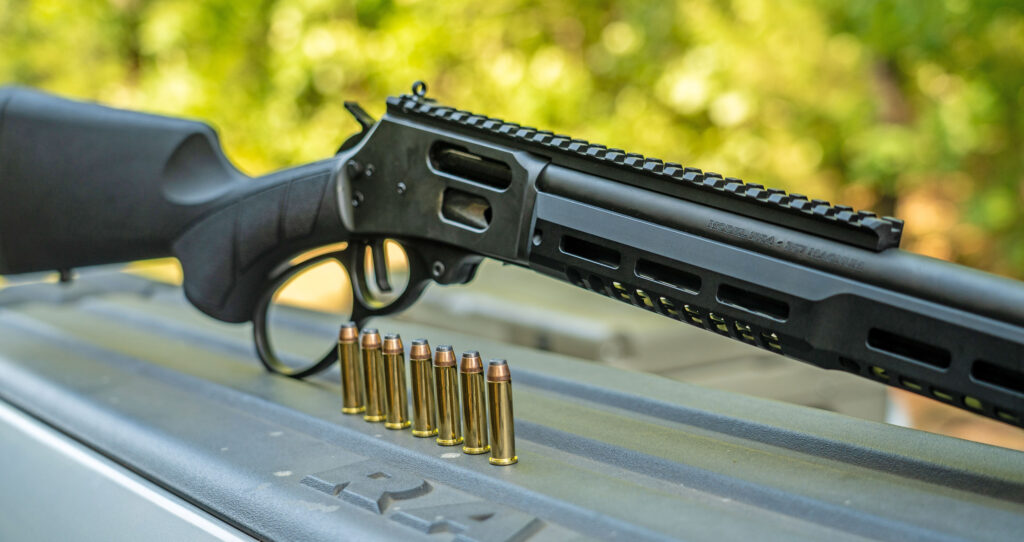
The 1854 Stealth Hunter takes the lever action somewhere it has rarely gone before. The 16.3-inch barrel wears an Armornite black finish and is threaded at 11/16×24 TPI, ready for a suppressor right out of the box. The forend is machined aluminum with 15 M-LOK slots, giving you real estate for accessories. A 10.5-inch Picatinny rail runs across the top for optics mounting. The front sight is an HiViz H3 tritium/fiber-optic unit that’s visible in full daylight or total darkness. A ghost-ring rear sight pairs with it for fast target acquisition under any conditions.
This is a lever action rifle you can hunt with at last light, run a can on for a quiet morning at the range, or mount an LPVO on for extended range work — all while cycling that same satisfying lever that started an American firearms revolution in 1854.
The Idea That Refused to Die
The Volcanic pistol didn’t survive. The Rocket Ball cartridge is a footnote in firearms history. The companies formed around those early experiments rose and fell and were reorganized and renamed. But the lever action mechanism that Horace Smith and Daniel Wesson patented on a cold February morning in 1854 never went away.
It won a war. It won the West. It fed families and defended homesteads and became one of the most recognizable shapes in American culture. And now, nearly 175 years after its first patent, it’s being chambered in .44 Magnum, fitted with tritium sights, threaded for suppressors, and mounted with red dots — still cycling smoothly, still feeding reliably, still turning heads at the range.
Not every idea in that original design was going to stick. But some ideas are simply too good to let die.
The lever action was always going to be one of them.