
The Badger & The Wolf: Picking The Right Suppressor For Your Hunting Rifle
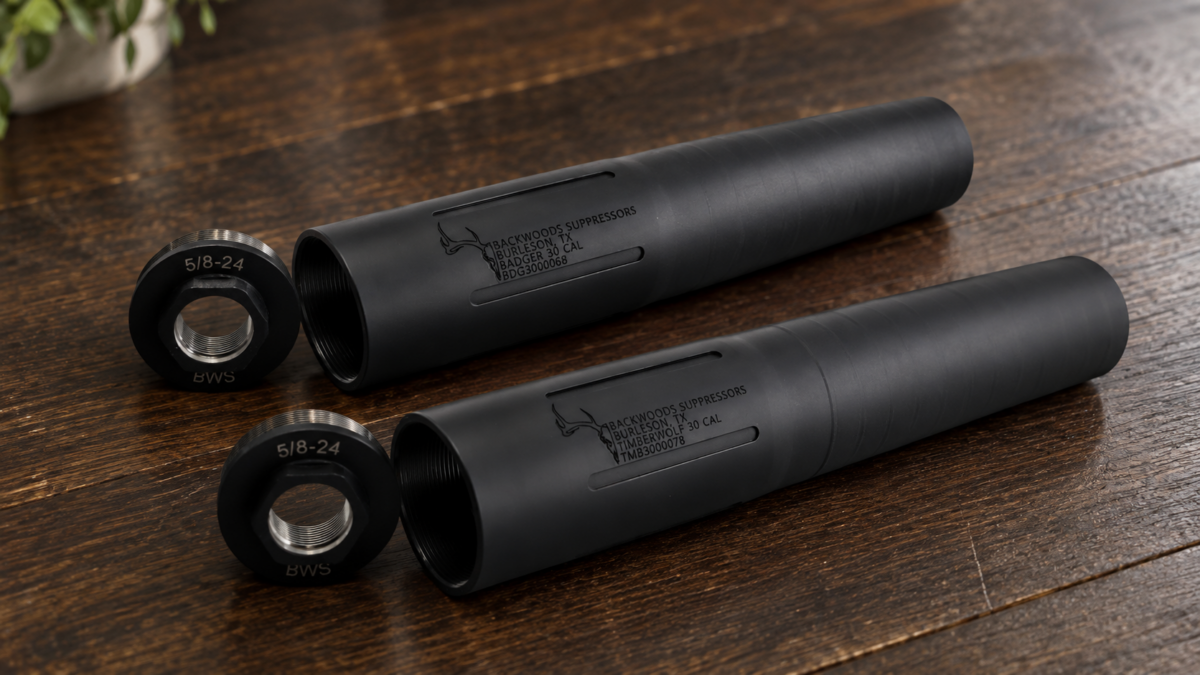
A hunting rifle suppressor has to solve a different problem than a can built primarily for high-volume range use. Hunters care about sound and flash reduction, but every ounce also matters when a rifle spends more time on your shoulder than on a shooting bench. That tradeoff is exactly what separates the Backwoods Badger SS from the Timberwolf Ti.
At first glance, these two .30-caliber suppressors have a lot in common. Both use a welded baffle design, both are HUB compatible, and both include a 5/8-24 direct-thread mount, a common thread pattern on bolt-action hunting rifles and AR-10-style rifles. They also share the same outer diameter and C-Series Cerakote finish.
Backwoods built both around hunting and precision shooting rather than sustained automatic fire. Its centerfire suppressors use the industry-standard 1.375×24 HUB interface, giving owners access to a wide range of compatible mounting systems.
So what separates the Badger from the Timberwolf?
Mostly, one thing: material.
Badger Vs. Timberwolf: Stainless Steel Or Titanium?
The Badger suppressor is built from 17-4 stainless steel. The Timberwolf Ti uses 6AL4V titanium.
That material change has a major effect on weight. Excluding the mounts, the Timberwolf suppressor itself comes in close to half the weight of the Badger. Backwoods specifically positions its titanium suppressors for hunters covering serious ground, while its stainless models trade additional weight for greater durability.
For a hunting rifle, that difference matters more than it might appear on a specification sheet.
A suppressor sits at the very end of the barrel, where extra weight is particularly noticeable. Carry a rifle several miles through steep country and the appeal of cutting suppressor weight becomes obvious. The rifle feels less front-heavy, and there is simply less equipment to carry all day.
That makes the Timberwolf Ti the easy choice when minimizing weight is the priority.
What Are The Tradeoffs Of A Titanium Suppressor?
Titanium saves substantial weight, but stainless steel has advantages of its own.
Titanium suppressors tend to produce more visible sparking than stainless steel, so the Badger has the advantage when minimizing muzzle flash is a major priority. Titanium also heats quickly and is less suited to repeated, high-volume firing than a heavier stainless design.
Backwoods makes an important distinction here. Its suppressors can tolerate some limited automatic fire, but the company designed them as hunting and precision-shooting tools. Excessive automatic or mechanically assisted rapid fire can damage them.
For the average bolt-action hunting rifle, that limitation is rarely consequential. Hunters generally fire one or a few carefully placed rounds, not long strings that rapidly build heat.
The more meaningful downside is cost.
Titanium is a more expensive material, and the Timberwolf reflects that. You are essentially paying more to remove a significant amount of weight from the end of the rifle. For someone hunting from a blind or walking a short distance from a vehicle, that may not be worth the premium. For someone climbing into the backcountry, it can be money well spent.
Is The Timberwolf Ti Worth It For A Hunting Rifle?
If your hunts involve miles on foot, we think so.
The Timberwolf suppressor is the model we would choose when building a lightweight mountain or backcountry hunting rifle. Once you have carried a rifle uphill for hours, the additional cost becomes easier to forget than the additional weight.
The Timberwolf also stands out because it brings an all-titanium construction into a comparatively accessible part of the suppressor market. Its purpose is straightforward: retain the sound-reduction benefits hunters want while removing as much unnecessary weight as practical.
Backwoods itself describes weight as a central consideration for its titanium models, which were developed with mobile hunters in mind.
Where The Badger SS Makes More Sense
The Badger takes the opposite approach.
At roughly 20 ounces including its supplied mount, it is not a lightweight hunting rifle suppressor. That figure is also worth putting in context because suppressor weights are not always published with the mounting hardware included.
What the Badger gives you in return is a durable 17-4 stainless construction at an aggressive price point. It offers excellent sound reduction, handles heat better than its titanium sibling, and does a better job controlling visible flash.
For hunters who spend most of their time in a blind, tree stand, truck-accessible property, or relatively easy terrain, the additional ounces may matter far less than the money saved.
There is also something appealing about a piece of hunting equipment you do not have to baby. Backwoods has described the stainless Badger as the workhorse of its .30-caliber lineup, while reserving titanium for applications where weight savings take priority.
Which Suppressor Is Quieter, The Badger Or Timberwolf?
This one is much closer than the difference in weight.
Both suppressors are built around the same basic mission, and sound performance is strong enough that we would not choose between them based on material alone. If maximum sound reduction is your overriding concern, the difference is close enough that the other characteristics become more useful deciding factors.
The Badger’s advantages are price, durability, heat tolerance, and flash reduction.
The Timberwolf’s advantage is unmistakable: weight.
That is a much easier distinction to feel in the field.
What Hunting Calibers Work With The Badger And Timberwolf?
Both are .30-caliber suppressors intended to cover the common cartridges hunters are likely to pair with this type of can. That includes popular big-game rounds such as .308 Winchester, .30-06 Springfield, .300 Win. Mag., .270 Winchester, 6.5 Creedmoor, and 7mm PRC, subject to the manufacturer’s caliber and barrel-length requirements for the specific host rifle.
Their HUB compatibility also gives hunters flexibility beyond the included direct-thread adapter. Backwoods confirms that its centerfire cans use the standard 1.375×24 HUB pattern, so owners are not locked into one proprietary mounting system.
For a bolt gun that will keep the suppressor installed most of the time, however, the included 5/8-24 direct-thread mount keeps the setup simple.
Picking The Right Backwoods Hunting Rifle Suppressor
The Badger and Timberwolf are unusually easy to compare because their biggest differences are not hidden in a long specification table. They come down to priorities.
If weight is the priority, choose the Timberwolf Ti. The substantial reduction at the end of the barrel makes the premium worthwhile for hunters covering real distance.
If value, durability, and flash reduction are the priorities, the Badger SS makes a strong case. It is heavier, but that stainless construction comes at a considerably lower price while retaining the characteristics that matter most once it is time to take a shot.
If sound is the priority, the choice is much closer. We would let weight, cost, and flash performance break the tie.
That is ultimately what makes these two suppressors complementary rather than redundant. The Badger is the rugged value play. The Timberwolf is the lightweight backcountry option.
Explore the Backwoods suppressor lineup at GrabAGun to find the model that makes the most sense for your hunting rifle and the way you actually hunt.
Frequently Asked Questions
What Is The Main Difference Between The Badger And Timberwolf Suppressors?
Material and weight. The Badger uses 17-4 stainless steel, while the Timberwolf Ti uses 6AL4V titanium. The titanium construction dramatically reduces weight, while the stainless Badger emphasizes durability, heat tolerance, flash reduction, and value.
Is A Titanium Suppressor Better For Hunting?
It can be, particularly for hunters who cover long distances on foot. Saving weight at the muzzle makes a rifle easier to carry and less front-heavy. For lower-volume hunting use, titanium’s reduced tolerance for sustained heat is generally much less important than it would be on a high-volume rifle.
Are The Badger And Timberwolf HUB Compatible?
Yes. Backwoods confirms that its centerfire suppressors use the industry-standard 1.375×24 HUB interface, allowing them to work with a variety of compatible mounting systems. Both models also include a direct-thread option for straightforward hunting-rifle setups.