
ATN BinoX 6 Dual Review: Thermal And Multispectral Binoculars Explained
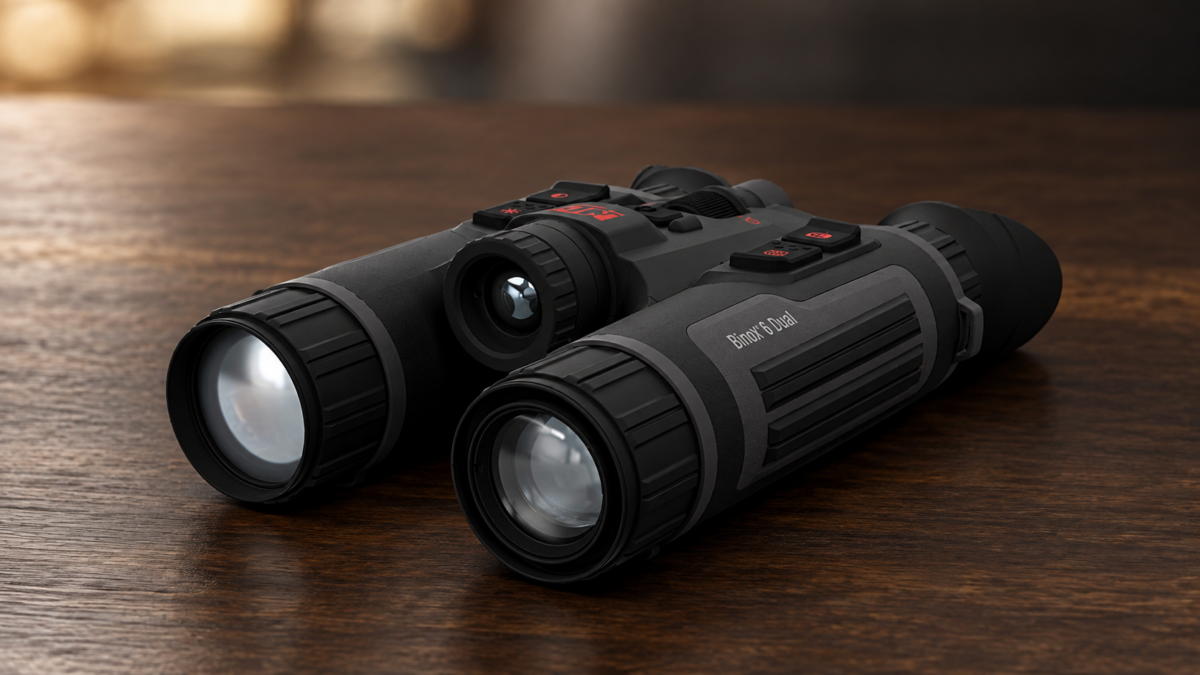
The ATN BinoX 6 Dual is less about being the absolute best optic in one category and more about putting several useful ways to see the world into a single handheld device. It combines thermal imaging, digital daytime viewing, infrared-assisted digital night vision, twilight viewing, recording, and a laser rangefinder in one binocular-style platform.
That combination is what makes the BinoX 6 Dual interesting.
A dedicated high-end thermal monocular can offer advantages if thermal performance is your only priority. Likewise, if you want the most natural daytime image, detail, and optical clarity possible, a quality traditional binocular with premium prism glass remains difficult for a digital system to match.
But those comparisons miss the point of the BinoX.
We think of it as the Swiss Army knife of observation optics. Instead of carrying separate thermal, night vision, daytime observation, and recording devices, you can handle all four jobs with one unit. The integrated laser rangefinder adds another useful capability without requiring another piece of gear.
Are Thermal Binoculars Better Than A Thermal Monocular?
The biggest advantage of thermal binoculars over a monocular is not necessarily additional thermal information.
The BinoX still relies on a single thermal imaging sensor. You are not getting two independent thermal perspectives simply because the housing looks like traditional binoculars. The advantage is the viewing experience.
Using both eyes can simply be more comfortable.
Anyone who has spent an extended period scanning through a monocular knows the routine. One eye is looking at an illuminated digital display while the other is closed or trying to ignore the outside world. Over longer observation periods, that can become tiring.
A binocular-style viewing system allows both eyes to participate in the experience. ATN provides an adjustable interpupillary distance of 60 to 74 mm along with diopter adjustment and 15 mm of eye relief. Those adjustments help users fit the viewing system to their eyes rather than repeatedly holding a single eyepiece in front of one eye.
For quick, lightweight scanning, a compact thermal monocular still makes plenty of sense. It can be smaller, simpler, and easier to carry.
For longer periods of observation, however, we prefer the comfort of viewing through a binocular-style device. That difference becomes more noticeable when you are continuously scanning fields, property, tree lines, livestock areas, or wildlife habitat instead of taking a few quick looks.
These Are More Than Thermal Binoculars
Calling the BinoX 6 Dual a pair of thermal binoculars only describes part of what it does.
Alongside the thermal sensor is a 4K CMOS digital camera. During daylight, that sensor provides a full-color digital image. As available light disappears, the same digital imaging system can operate in night mode with assistance from the infrared illuminator.
The basic concept is similar to other IR-assisted digital night vision systems. An infrared illuminator projects light that is invisible or difficult for the naked eye to perceive, while the digital imaging sensor detects that illumination and converts it into an image you can see on the display.
That gives the BinoX another important capability in total darkness.
Thermal and digital night vision solve different problems. Thermal is excellent at revealing temperature differences and finding heat signatures without requiring visible illumination. Digital night vision provides a more conventional visual representation of the scene and can reveal details that are not based on heat.
Having both available in one device means you can change the way you are looking at a scene without changing optics.
ATN also includes a twilight mode intended to bridge the transition between normal daylight and darkness. The result is what the manufacturer describes as a four-mode system covering day, night, thermal, and twilight observation.
That is why “multispectral” is a better description of what these binoculars actually are.
Can You Use The ATN BinoX 6 Dual During The Day?
Yes, and daylight operation gives these multispectral binoculars an advantage that is easy to overlook: recording.
We would not choose a digital BinoX strictly because we wanted the best possible traditional daytime binocular experience. If optical image quality, natural color, fine detail, and premium magnification are the entire goal, high-quality conventional glass remains the benchmark. A well-built traditional binocular using premium prism and lens systems does not need to translate the world through a camera sensor and electronic display before the image reaches your eyes.
The BinoX is doing something different.
Its 1.8-inch CMOS sensor captures 3840×2160 Ultra HD video, and the unit includes 64 GB of internal storage. ATN specifies 4K daytime recording and 1080p thermal recording, along with an internal gallery that lets you review captured images and video on the device.
That means the same optic you use to observe during the day can document what you are seeing.
Switch to digital night vision after dark and you can continue recording. Switch to thermal and you can record that perspective too.
For wildlife observation, scouting, property inspection, documenting animals, or simply saving something unusual that appears in front of you, recording changes the usefulness of the daytime mode. Traditional binoculars may give you a better purely optical view, but they cannot record that view without adding another device.
One Optic That Can Replace Several Devices
This is where the BinoX 6 Dual makes the strongest case for itself.
It is not necessarily the best thermal optic available if your only criterion is thermal image performance. It is not trying to replace the finest traditional optical binoculars either.
Instead, it consolidates capabilities.
You effectively have a thermal viewer, a digital night vision device, a daytime digital binocular, and a video recorder in the same housing. The built-in laser rangefinder can measure distance without requiring you to put down the binoculars and reach for another device.
ATN also includes Dual View Switching and picture-in-picture functionality, adding more flexibility to how information is displayed while you observe.
For someone who normally carries several observation tools, that consolidation has real value.
More specialized equipment will still win specialized contests. The appeal here is getting a remarkably broad toolbox in one package weighing roughly 1.56 to 1.61 pounds depending on the thermal sensor configuration. The magnesium-alloy housing is IP67 rated, and ATN provides a standard tripod mount for situations where extended stationary observation makes more sense than handheld scanning.
Which ATN BinoX 6 Dual Resolution Should You Choose?
For the best image quality, our preference is the 640×512 model.
The higher-resolution thermal sensor gives you substantially more thermal information to work with, particularly when identifying smaller details or using digital magnification. The BinoX 6 Dual 640 also has the lowest base magnification of the three models at 3x, compared with 5.5x for the 384 and 6x for the 256.
On paper, lower magnification can sound like a disadvantage.
At night, we found the opposite can be true.
When we are scanning rather than studying one distant object, the wider thermal field of view is useful. The 640 model has a listed thermal field of view of 12.52° × 9.41°, compared with 7.53° × 5.65° on the 384 model. That wider view makes it easier to take in more terrain at once and locate movement or heat signatures before deciding whether to zoom.
For nighttime scanning, we prefer that tradeoff.
The 384×288 Model Is The Middle Ground
The 384×288 version remains a very viable option if you want to open up the nighttime world without stepping all the way to the 640 model.
Its 384×288 sensor, ≤15 mK thermal sensitivity, 5.5-44x magnification range, and listed 2,750-meter detection range give it considerably more thermal resolution than the entry-level model while retaining the same 4K digital day and night system.
In practical terms, the image can look very good at lower magnification. The limitations become increasingly apparent as digital zoom asks the sensor to stretch fewer available thermal pixels across the display.
For many buyers, the 384 model is likely to be the balance point between price and resolution.
The 256×192 Model Gets You Into Thermal At An Attractive Price
The 256×192 model is compelling because it lowers the cost of entry into this type of multispectral system.
You still receive the 4K CMOS sensor, IR-assisted night vision, rangefinder, recording, Wi-Fi, GPS, 64 GB of storage, and the other major platform features. The sacrifice is primarily thermal resolution and sensitivity. It uses a 256×192 thermal detector rated at ≤20 mK, with 6-48x magnification and a listed detection range of 1,500 meters.
If your main goal is simply discovering what thermal observation makes visible after dark, the 256 can do that at an attractive entry point.
The tradeoff appears when you want more detail.
At base magnification, the experience can be impressive, especially if you have never spent much time behind a thermal sensor. Start applying substantial digital zoom, however, and the advantage of having 384×288 or 640×512 thermal resolution becomes increasingly obvious.
That is the reason we would think carefully before choosing solely on initial price. The 256 model can show you what is possible, but it may also make you want a higher-resolution thermal sensor once you understand how useful the technology can be.
The BinoX 6 Dual Is About Versatility, Not A Single Specification
The ATN BinoX 6 Dual makes the most sense when you judge the complete system rather than trying to make it win a head-to-head competition with every dedicated optic.
A premium traditional binocular is still our preference when pure optical daytime image quality is the goal. A dedicated high-end thermal device may be the better choice when maximum thermal performance is all that matters.
But neither comparison captures what the BinoX does well.
These multispectral binoculars give you several distinct ways to observe the same environment from one device. You can detect heat thermally, examine a scene through the digital day or night camera, use IR illumination in complete darkness, measure distance, and record what you are seeing.
For buyers who value that flexibility, the BinoX becomes much more than another thermal viewer.
If maximum thermal image detail is the priority, we recommend starting with the 640×512 model. The 384×288 version offers an appealing balance of resolution and cost, while the 256×192 model provides a more accessible way to experience the possibilities of thermal and multispectral viewing.
Explore the current ATN BinoX 6 Dual lineup at GrabAGun to compare the available sensor resolutions and decide which combination of image quality, magnification, and price best matches the way you plan to use it.
Frequently Asked Questions
Are Thermal Binoculars More Comfortable Than A Monocular?
For extended observation, they can be. Although the BinoX uses a single thermal imaging sensor, its binocular-style viewing system lets you use both eyes instead of continuously viewing a digital display with one eye. Adjustable interpupillary distance and diopter settings also allow the viewing system to be fitted to the individual user.
Can The ATN BinoX 6 Dual See In Complete Darkness?
Yes. Thermal mode detects heat rather than relying on visible light, while digital night vision can use the built-in infrared illuminator to illuminate a scene for the CMOS sensor. ATN lists an effective digital night vision distance of up to 400 meters.
Is The 640×512 BinoX 6 Dual Worth Choosing Over The 384×288 Model?
Choose the 640 model when thermal image detail is the priority. Its 640×512 sensor gives the system significantly more thermal resolution, and its 3x base magnification produces a wider thermal field of view that we prefer for nighttime scanning. The 384 model costs less while still providing a ≤15 mK sensor and significantly greater resolution than the entry-level 256 version.