
HK CC9 Overview: HK’s Purpose-Built Micro-Compact 9mm
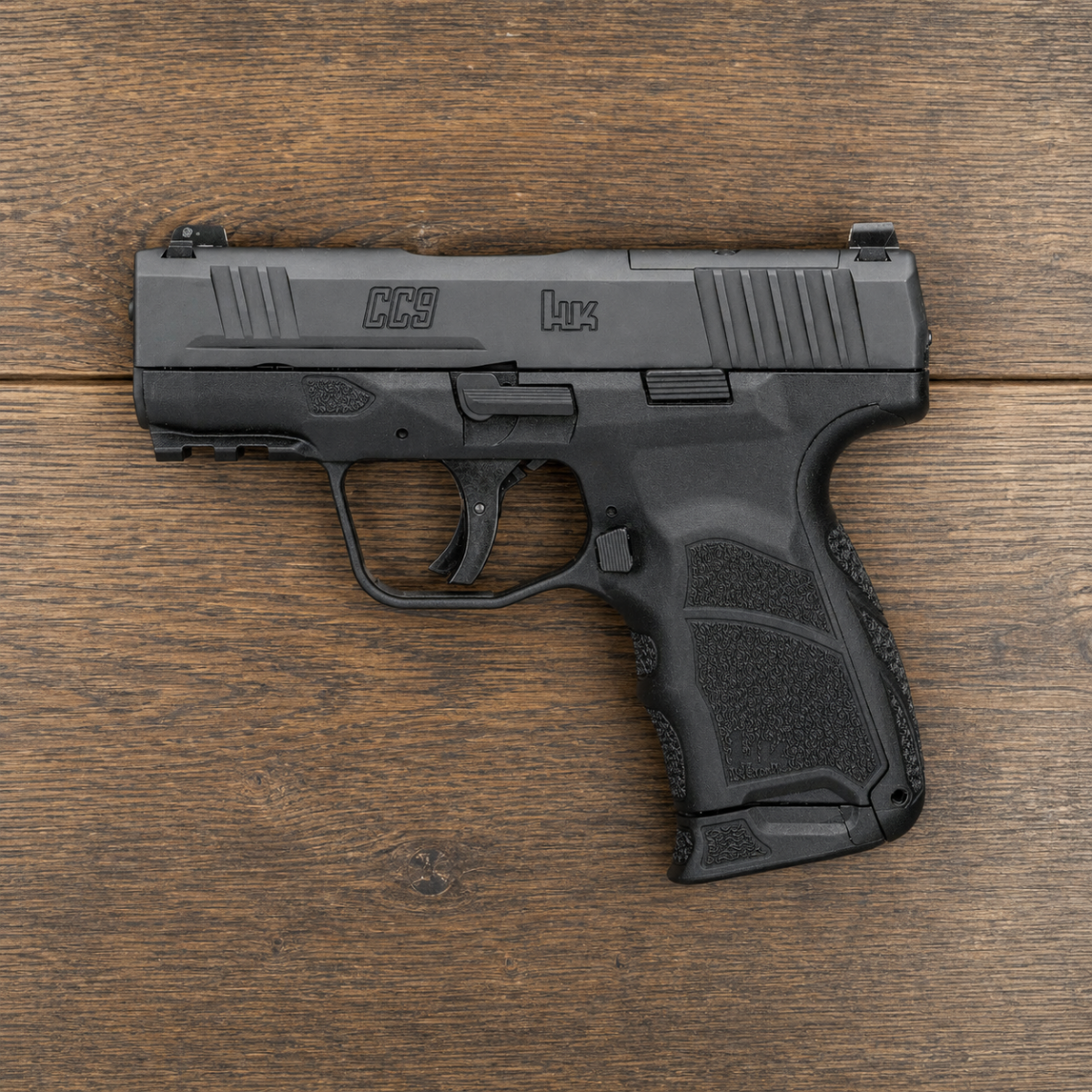
The HK CC9 is not a brand-new handgun. HK introduced it in October 2024 as its first true micro-compact pistol, designed and produced in the United States specifically for the American concealed-carry market. Nearly two years later, it remains the smaller, less expensive and more conventionally American option in HK’s growing carry lineup.
That last point needs explaining because HK now sells two pistols with similar names.
The CC9 is a separate American-developed platform with push-button magazine releases and a direct-mount optic cut. The VP9CC arrived in April 2026 as a German-made, scaled-down member of the VP9 family with paddle magazine releases, charging supports and more grip-fitting options. The newer VP9CC did not replace the CC9. It gave HK buyers a more expensive alternative built around traditional VP9 features.
For many concealed carriers, the original CC9 remains the easier pistol to understand and the better value.
The HK CC9 Was Built For Carry From The Start
The CC9 measures 6.03 inches long and 0.99 inches wide. Without a magazine, it weighs 18.4 ounces. The 10-round magazine keeps the height to 4.60 inches, while the extended 12-round magazine raises it to 4.92 inches and provides more support beneath the little finger.
Those dimensions put it alongside the established micro-compact 9mm pistols people already carry. It is not a thick subcompact duty pistol with the grip shortened. The slide, frame and controls were designed around concealment.
The difference between the two included magazines is useful in practice. The flush 10-rounder minimizes grip length, which is usually the hardest part of a pistol to hide. The 12-round magazine adds only 0.32 inch but gives most hands a more complete grip. Carry the shorter magazine when concealment is critical and keep the longer one as a reload, or use the 12-rounder when clothing allows it.
Two backstraps adjust the distance between the rear of the grip and the trigger. The change is modest, but worthwhile on a small pistol where a few millimeters can determine whether the trigger finger sits naturally or reaches too far across the shoe.
It Shoots Better Than Its Size Suggests, But It Is Still A Small 9mm
HK built the CC9 around a one-piece steel chassis that carries the locking area, frame rails and fire-control components. That rigid internal structure is one of the more substantial design choices hidden beneath the polymer grip module.
The trigger is factory rated at approximately five pounds, with 0.24 inch of travel and a short 0.12-inch return. It has a clear wall rather than the soft, rolling break found on some small striker-fired pistols.
Independent range testing has generally found the pistol controllable for its weight. Outdoor Life’s 2026 test team noted that it was easier to manage than many micro-compacts and made repeatable hits on practical-size steel at 50 yards. Shooting Illustrated reported comfortable recoil, useful grip texture and no malfunctions during its evaluation.
None of that turns an 18.4-ounce pistol into a full-size VP9. The CC9 still moves more under recoil than a larger handgun, especially with the flush magazine. Shooters with large hands or limited experience with lightweight 9mm pistols should handle one and shoot it before choosing it for daily carry.
A separate 1,000-round review recorded no firing malfunctions but found that riding the slide forward could occasionally leave it slightly out of battery early in the test. The issue became less noticeable with use, and the pistol’s out-of-battery safety prevented it from firing in that condition. The practical lesson is familiar: pull the slide fully to the rear and let it run forward under spring pressure.
Is The HK CC9 Optics Ready?
Every standard HK CC9 is optics ready.
The slide accepts RMSc and Holosun K-pattern optics directly, without the tall adapter-plate stack used on many older pistols. The rear sight remains behind the optic cut, allowing the standard-height sights to remain usable with a suitably low-mounted dot.
There is an important difference between model packages. Standard optics-ready models ship with a high-visibility tritium front sight and a plain serrated rear. Factory optic-equipped models use blacked-out front and rear sights. HK currently lists versions with a Holosun 407K or an open-emitter Vortex Defender-CCW.
Buy the standard model when you prefer iron sights or already know which compatible optic you want. The factory optic packages make more sense when you want a complete configuration and do not want to source the sight and mounting hardware separately.
Always verify the exact manufacturer number before ordering. CC9 packages can differ in optic, sight configuration, magazine capacity and finish even when the product photos look nearly identical.
The Controls Favor American Carry-Gun Habits
The CC9 has mirrored magazine-release buttons and slide-stop levers. Left-handed shooters receive the same controls as right-handed shooters without reversing parts.
HK chose a push-button magazine release instead of the paddle release used on the VP9CC and many earlier HK pistols. Longtime HK shooters may prefer the paddle, but the button is familiar to anyone trained on common American service and carry pistols.
The frame also includes a short Picatinny-style rail. It provides room for a compatible compact light or laser, although buyers should confirm fit carefully. A small pistol can have a standard-looking rail while still requiring an accessory designed around its short dust cover and trigger guard.
The safety system is passive. It includes a trigger safety, firing-pin and drop protection, and an out-of-battery safety. There is no external manual safety on the standard pistol.
How Thoroughly Was The CC9 Tested?
HK reports firing more than 750,000 rounds across CC9 development and subjecting the platform to NATO AC/225 testing. The program included exposure to temperature extremes, sand, dust, mud and drop testing. That figure applies to the development program, not a single production pistol.
The 3.32-inch cold-hammer-forged barrel is made in Germany from cannon-grade steel, while the rest of the pistol is designed, developed and produced in the United States. The slide and barrel receive a DLC coating, and the platform is rated for +P ammunition.
The testing claims are not a substitute for evaluating an individual pistol with its magazines, optic and chosen ammunition. They do show that HK treated the CC9 as a duty-grade engineering project rather than a quick attempt to enter the micro-compact market.
HK CC9 Vs. VP9CC: Which One Makes More Sense?
The VP9CC is newer, but newer does not automatically mean better for every buyer.
Both pistols use 10- and 12-round magazines and are almost identical in overall length. The VP9CC is German-made, weighs 17.64 ounces without a magazine and uses the VP family’s paddle release, rear charging supports and six interchangeable backstraps. Its optics system is designed to mount compatible sights lower than conventional plate systems.
The CC9 is slightly heavier, uses a longer 3.32-inch barrel, offers push-button controls and mounts RMSc or K-pattern optics directly. Its starting MSRP is $699, compared with $1,049 for the optics-ready VP9CC.
Choose the CC9 when you prefer push-button controls, direct-mount micro optics and a lower purchase price.
Choose the VP9CC when traditional VP ergonomics, a German-made pistol, paddle releases and greater grip adjustment justify the added cost.
They are different answers to the same carry-gun question. The CC9 is not obsolete simply because the VP9CC now exists.
The CC9 Has Settled Into The Right Place
The HK CC9 entered the market late, but it did not arrive unfinished.
It carries easily, gives the shooter a practical choice between 10- and 12-round magazines and includes sights that do not need immediate replacement. The direct optic cut is simple, the controls work from either side and the internal chassis is more substantial than the exterior suggests.
Its limitations are typical of the category. It remains a light, short-gripped 9mm. The 12-round capacity is competitive rather than class-leading, and some shooters will prefer the fuller grip and paddle controls of the VP9CC.
The difference in price keeps the decision straightforward. The CC9 delivers the features most concealed carriers need without charging for every premium VP9CC feature.
Shop the current HK CC9 selection at GrabAGun to compare standard optics-ready pistols, factory Holosun and Vortex packages, color finishes and compliant-capacity models. Confirm the manufacturer number, included magazines and sight configuration before ordering. All firearm purchases and transfers must comply with applicable federal, state and local laws.
Frequently Asked Questions
When Was The HK CC9 Released?
HK introduced the CC9 on October 16, 2024, and began shipping it at launch. It is an established model rather than a new release for 2026.
How Many Rounds Does The HK CC9 Hold?
Standard packages include one flush-fitting 10-round magazine and one extended 12-round magazine. Restricted-capacity models include two 10-round magazines.
Is The HK CC9 Made In Germany?
Most of the pistol is designed, developed and produced in the United States. Its cold-hammer-forged barrel is manufactured in Germany.