
A Guide to Reptilia Optic Mounts for AR Rifles
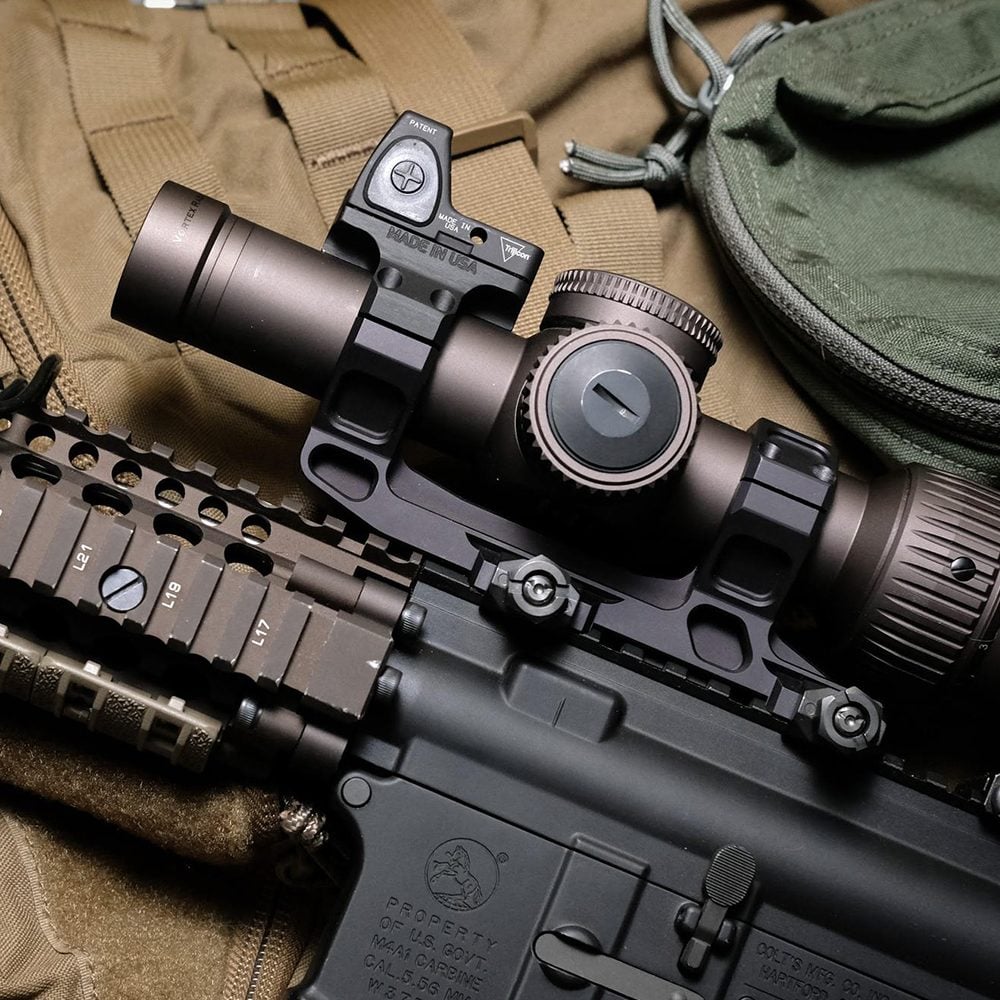
Reptilia optic mounts give AR owners several ways to configure magnified scopes, standalone red dots, and secondary optics. The product line is built around dedicated mounting solutions rather than a universal mount that attempts to accommodate every optic and application.
That distinction matters because choosing an optic is only part of building a functional sighting system. The mount determines the optic’s height, position, compatibility, and relationship to the rest of the rifle. A poor match can create eye-relief problems, an awkward head position, or interference with other equipment.
Reptilia divides its primary optic-mount offerings into three main groups (AUS, DOT, and ROF). AUS mounts support magnified scopes and low-power variable optics. DOT mounts attach standalone red dots to Picatinny rails. ROF mounts add a secondary red dot to a compatible magnified-optic setup.
Understanding those categories makes it easier to narrow the options before comparing individual models.
Why the Optic Mount Matters
A quality optic cannot perform as intended if the mount does not fit the scope, rail, and shooter correctly.
An AR scope mount must first match the scope tube’s diameter. Common LPVO and riflescope tube sizes include 30mm and 34mm, although other diameters are also available. Even a well-made mount is unusable if its rings do not match the optic.
Height is the next major consideration. Mount height affects cheek position, head position, sight-over-bore distance, and how naturally the shooter can find the sight picture. A lower mount generally supports a more traditional cheek weld, while a taller mount allows a more upright head position.
The mount must also place the optic far enough forward or backward to establish proper eye relief. This is especially important on AR-pattern rifles, where a cantilever-style mount often helps position an LPVO correctly without extending the mount onto the handguard.
Material, hardware, and rail attachment are also worth reviewing. Many Reptilia AR optic mounts are machined from billet 7075-T6 aluminum and use hard-anodized finishes. AUS and DOT models use low-profile mounting hardware designed for M1913 Picatinny rails.
Reptilia AUS Mounts for LPVOs and Riflescopes
The AUS is Reptilia’s primary magnified-optic mounting system. It combines two scope rings and a cantilevered Picatinny-rail base in a single assembly.
Reptilia offers AUS mounts for several scope-tube diameters, including common 30mm, 34mm, and 35mm optics. Available configurations vary by diameter, height, color, and mount length.
Most buyers should begin with three questions:
- What is the scope-tube diameter?
- What mount height is appropriate?
- Does the scope body require standard or shortened ring spacing?
The tube diameter must match exactly. A 30mm optic requires a 30mm mount, and a 34mm optic requires a 34mm mount.
Ring spacing is easy to overlook. Most conventional scopes provide enough straight tube area for standard rings. Some compact optics have shorter main tubes, larger turret housings, or limited mounting space. Reptilia offers a shortened 34mm AUS configuration for compatible compact scopes that do not provide enough room for the standard ring spacing.
The AUS is machined from a single piece of billet 7075-T6 aluminum. It attaches to an M1913 Picatinny rail using a spring-loaded nitrided steel clamp and a cross bolt that sits flush with the side of the mount.
The integrated design also gives the AUS a second purpose. It serves as the base for several Reptilia accessories, including ROF red dot mounts, offset mounts, bubble levels, and Diving Board rail sections.
Understanding Reptilia AUS Mount Heights
Reptilia offers AUS configurations at several heights, including approximately 1.54 inches, 1.70 inches, and 1.93 inches. Not every tube diameter or mount format is available at every height, so buyers should verify the exact model before ordering.
1.54-Inch Mounts
The 1.54-inch height, also listed as 39mm on some Reptilia products, places the optic relatively close to the rifle’s bore.
This is a conventional height for AR scope mounts and can work well for shooters who prefer a firm cheek weld. It is also a logical starting point for rifles used frequently from prone, supported, or bench positions.
A lower optical axis creates less mechanical offset between the optic and bore than a taller mount. Shooters still need to understand their sight-over-bore measurement, particularly at close distances, but the offset is smaller than it would be with a 1.93-inch mount.
1.70-Inch Mounts
A 1.70-inch mount sits between traditional and taller optic heights. It raises the sightline enough to support a more upright head position without moving as high as a 1.93-inch configuration.
This middle height may appeal to shooters who find a 1.54-inch mount slightly low but do not need the additional elevation of the tallest option.
1.93-Inch Mounts
A 1.93-inch AR scope mount places the optic noticeably higher above the rail. The elevated sightline can make it easier to maintain an upright head position and may help when equipment makes it difficult to settle into a low cheek weld.
The tradeoff is increased sight-over-bore distance. That difference becomes most noticeable at close range, where the bore is still physically below the line of sight. A tall mount may also feel less natural during extended prone shooting.
No single height is correct for every rifle or shooter. Intended use, stock position, shooting stance, facial structure, and other equipment all affect the decision.
Reptilia DOT Mounts for Standalone Red Dots
An LPVO and secondary red dot can be useful on a multipurpose rifle, but not every AR needs two optics.
Reptilia DOT mounts are designed for rifles using a red dot as the primary sight. Each model uses a specific optic interface, eliminating the need for a universal top plate or multiple adapter layers.
The DOT lineup includes options for several popular optic families, such as:
- Aimpoint Micro-pattern optics
- Aimpoint ACRO and Steiner MPS optics
- Trijicon MRO optics
- Trijicon RMR and SRO-pattern optics
- Holosun AEMS and 509T optics
- Leupold DeltaPoint Pro and EOTech EFLX optics
Available heights and formats depend on the optic footprint. Reptilia offers select DOT mounts in low, lower-one-third, 1.93-inch, and offset configurations.
A footprint-specific mount simplifies the selection process, but buyers still need to verify the exact optic model. Manufacturers sometimes use different mounting patterns across products within the same brand.
Lower-One-Third or 1.93-Inch Red Dot Mounts?
The appropriate DOT mount height depends on the rifle and the shooter’s preferred head position.
A lower-one-third mount places the iron sights in the lower portion of the red dot’s viewing window when compatible backup sights are installed. This provides a slightly higher sightline than an absolute co-witness configuration while retaining access to the iron sights.
A 1.93-inch red dot mount raises the optic farther above the rail. This can support a more upright stance and provide additional clearance around equipment mounted near the top rail.
The higher position also increases mechanical offset. That does not make a tall mount inherently better or worse, but it changes how the rifle behaves at close distances.
Buyers should avoid choosing a mount solely because a particular height is popular. The better choice is the one that produces a repeatable head position and works with the complete rifle setup.
Adding a Secondary Red Dot With a ROF Mount
A magnified optic offers identification and aiming capability at distance, but even an LPVO set to its lowest magnification does not feel identical to a dedicated red dot.
Reptilia’s ROF system allows a compatible miniature red dot to be installed alongside a magnified optic. ROF stands for Ring of Fire, and the system includes options for several scope diameters and red-dot footprints.
The two primary configurations are the ROF-90 and ROF-45.
ROF-90 Top-Mounted Red Dots
The ROF-90 positions the red dot at the 12 o’clock position above the scope. It replaces the upper portion of the compatible front scope ring and centers the secondary optic over the rifle.
To use the red dot, the shooter maintains the rifle in an upright position and raises the head to the higher sightline.
A top-mounted red dot may be useful when the shooter wants to keep the rifle vertical during transitions. Because the optic remains centered over the bore, the horizontal relationship between the sight and bore stays consistent.
The elevated position also creates a substantial sight-over-bore distance. Shooters should account for that offset when zeroing and using the secondary optic at close range.
ROF-45 Canted Red Dots
The ROF-45 places the red dot at an angle beside the primary optic. The shooter rotates the rifle to bring the dot into view.
This setup keeps the secondary sight lower than many 12 o’clock configurations, but it introduces both horizontal and vertical offset. The shooter should zero and train with the sight in its actual canted position rather than treating it like a conventionally mounted red dot.
Reptilia also offers AUS Offset mounts that attach to either side of the AUS base. This gives shooters another way to add a canted optic without replacing a scope-ring cap.
Confirming ROF Compatibility
ROF accessories are not universal. Buyers need to match both sides of the system.
The ring diameter must fit the magnified-optic mount. A 30mm ROF component cannot replace a cap on a 34mm mount.
The mounting surface must also match the red dot. Common footprints include Trijicon RMR and SRO, Aimpoint Micro, Aimpoint ACRO and Steiner MPS, and Leupold DeltaPoint Pro.
Similar-looking red dots do not always use the same mounting pattern. Compatibility should be confirmed by the optic model and mount description rather than by appearance alone.
Some ROF models are designed for Reptilia AUS mounts, while certain configurations also fit compatible Geissele Super Precision mounts. The individual product listing should identify the intended base mount, ring diameter, and optic footprint.
How to Choose the Right Reptilia Optic Mount
The simplest way to compare Reptilia optic mounts is to work from the primary optic outward.
For an LPVO or traditional riflescope, begin with the optic’s tube diameter. Next, determine whether the scope body fits standard ring spacing. Then choose between the available heights based on shooting position and preferred head placement.
For a standalone red dot, identify the exact mounting footprint before comparing height options. Do not assume that optics from the same manufacturer share an interface.
For a rifle using both an LPVO and red dot, decide whether the secondary optic should sit above the scope or at an angle. Then match the ROF or offset mount to the scope-ring diameter and red-dot footprint.
The final check should consider the rifle as a complete system. Confirm eye relief, turret clearance, charging-handle access, backup-sight clearance, and space for lights, lasers, or other accessories.
Follow the Correct Installation Specifications
Correct installation is as important as selecting the correct AR optic mount.
Reptilia specifies 45 inch-pounds for the AUS clamp cross bolt. The company recommends 15 inch-pounds for the ring-cap screws but advises owners to check the scope manufacturer’s instructions because torque requirements can vary.
Ring-cap screws should be tightened gradually in an X pattern. The gap between the cap and lower ring should remain even on both sides.
Eye relief and scope level should be set before the screws receive their final torque. An inch-pound torque wrench is preferable to estimating torque by feel.
Thread-locking compound is not always required. Reptilia states that a small amount of purple Loctite 222 can be used on AUS hardware, but it is not necessary. Product-specific installation instructions should take priority whenever specifications differ.
A Modular Approach to AR Optics
Reptilia’s optic-mount lineup is organized around distinct roles.
The AUS supports magnified optics and serves as the foundation for additional accessories. ROF mounts add top-mounted or canted red dots to compatible scope setups. DOT mounts provide dedicated interfaces for rifles using a standalone red dot.
That modular structure gives AR owners room to configure the rifle around its actual use rather than forcing every optic into the same mounting arrangement.
The best option is not necessarily the tallest mount or the setup with the most accessories. It is the configuration that matches the optic, supports a consistent shooting position, and keeps the rifle’s controls and equipment accessible.
Frequently Asked Questions
Are Reptilia ROF Mounts Compatible With Every AUS Mount?
ROF compatibility depends on the scope-ring diameter, ROF model, and red-dot footprint. The accessory must match the AUS mount’s diameter and provide the correct interface for the selected red dot.
What Height Reptilia AUS Mount Should I Choose?
A 1.54-inch mount provides a more traditional sightline, while a 1.70-inch mount offers a middle position. A 1.93-inch mount supports a more upright head position but creates greater sight-over-bore distance. The best height depends on shooting position, stock setup, equipment, and personal fit.
Can a Reptilia DOT Mount Fit More Than One Red Dot?
Some red dots share a mounting footprint, so a DOT mount may fit several compatible models. Buyers should confirm compatibility using the exact optic and mount specifications rather than relying only on the brand name or appearance.
Shop Reptilia optic mounts at GrabAGun to compare available AUS, ROF, and DOT configurations by optic fit, tube diameter, height, and color.